Qwen-Image-2.1: A Powerful New Open-Source Model for AI Image Editing
AI image editing is rapidly moving beyond simple background replacement and style transfer. Modern models are increasingly expected to understand objects, preserve identities, combine multiple visual references, edit precise regions, render readable text, and handle professional design assets.
Qwen-Image-2.1, released by the Qwen team on September 20, 2026, is one of the latest models attempting to bring those capabilities together in a single open-source system. Rather than treating image generation and image editing as two separate tasks, Qwen-Image-2.1 supports both within the same architecture.
Its combination of multi-image editing, localized changes, transparent-image support, improved subject preservation, and relatively compact architecture makes it particularly interesting for designers, developers, e-commerce platforms, content creators, and AI application builders.
What Is Qwen-Image-2.1?
Qwen-Image-2.1 is a unified text-to-image generation and image-editing model developed by the Qwen team.
The visual generation component contains approximately 7 billion parameters and uses 32 Single-Stream DiT layers. According to Qwen, the model was designed to strike a balance between visual quality, computational efficiency, and editing versatility.
That 7B-scale design is important because high-quality image models can demand substantial GPU memory and inference resources. Qwen-Image-2.1 focuses on reducing some of that computational burden while still supporting advanced editing workflows.
Its architecture also uses mixed-granularity attention and prefix KV-cache reuse, techniques intended to make inference more efficient, particularly when several reference images or editing instructions are supplied.
Image Generation and Editing in One Model
One of the biggest changes in Qwen-Image-2.1 is the decision to unify image creation and image editing.
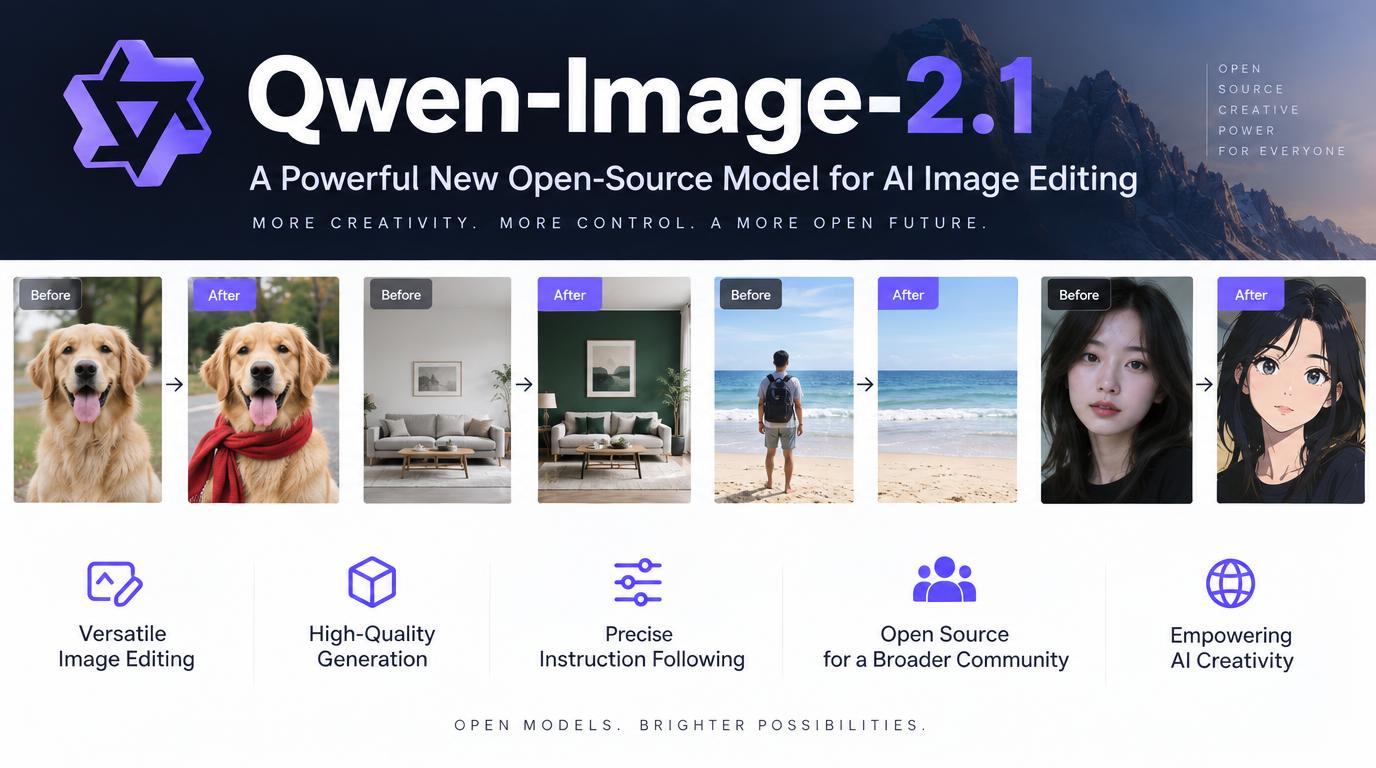
A user can ask the model to generate an entirely new image from text, but the same model can also accept an existing image and modify it according to natural-language instructions.
For example, a user could provide a photograph and ask the model to:
- replace the background with a sunset beach,
- change a person’s clothing,
- remove an unwanted object,
- modify hair color,
- insert another subject,
- alter text appearing within the image,
- or extract an object onto a transparent background.
This reduces the need to switch between dedicated generation, inpainting, background-removal, and compositing models.
Support for Up to 10 Reference Images
One of Qwen-Image-2.1’s most notable editing capabilities is support for up to 10 reference images.
Multi-reference editing opens up considerably more sophisticated workflows than traditional single-image editing.
For instance, several portrait photographs can be supplied and combined into a new group photograph. Likewise, a fashion workflow could provide separate images of a person, jacket, shoes, handbag, and hat, with the model instructed to assemble them into a coherent outfit.
Qwen also demonstrates interior-design scenarios where multiple furniture references are incorporated into a newly generated room.
This capability could be particularly useful for product visualization, virtual try-on systems, advertising, interior design, character composition, and creative previsualization.
More Precise Local Image Editing
AI image editors often struggle with a fundamental problem: understanding exactly which part of an image should change.
Qwen-Image-2.1 addresses this with several forms of localized editing.
Users can identify editing regions using circles, painted annotations, or dedicated masks. The model can then interpret both the marked region and the accompanying natural-language instruction.
For example, different colored circles can identify different objects while the prompt specifies a unique edit for each area.
That makes workflows closer to traditional visual editing software, where users select an area before applying an operation, while retaining the flexibility of natural-language instructions.
Better Preservation of People and Products
Another major challenge in generative image editing is maintaining visual consistency.
When changing a background, outfit, pose, or scene, generative models can accidentally alter a person’s face, modify a product’s shape, or introduce subtle differences that make the result unusable.
Qwen says Qwen-Image-2.1 improves fidelity preservation for both people and products.
This matters considerably for commercial applications.
In an e-commerce workflow, for example, a retailer may want to place the exact same shoe, handbag, watch, or clothing item into several marketing environments. If the AI changes the product itself, the generated image becomes much less useful.
Improved reference fidelity makes AI image editing more practical for these use cases.
Native Transparent Image Editing
Transparency is another standout feature.
Qwen-Image-2.1 can generate and edit RGBA images, meaning images that contain a transparency or alpha channel.
Instead of generating an object against a white or simulated transparent background, the model can produce an actual transparent asset.
It can also take an ordinary RGB photograph and extract a desired subject as a transparent RGBA layer.
That could significantly streamline common design workflows involving:
- logos,
- product cutouts,
- stickers,
- character assets,
- presentation graphics,
- website components,
- advertising creatives,
- and layered visual compositions.
Qwen-Image-2.1 can also edit elements inside an already transparent image while preserving the transparent background.
This makes the model more relevant to graphic-design workflows rather than limiting it to conventional AI art generation.
Improved Text Rendering
Text remains one of the hardest problems for generative image models.
Earlier image generators frequently produced misspelled words, malformed letters, inconsistent typography, or text that failed to fit naturally into the surrounding design.
Qwen says Qwen-Image-2.1 improves text rendering by considering not only textual content but also typography, layout, and its relationship to the overall composition.
Better text rendering could make the model more useful for posters, advertisements, social-media graphics, packaging concepts, signs, promotional material, and presentation assets.
It also strengthens image-editing workflows where existing text must be replaced without rebuilding the entire visual.
Improved Portraits and Visual Quality
Qwen-Image-2.1 also targets more realistic textures, lighting, and fine details.
The team highlights improvements in portrait lighting and overall aesthetic refinement, which can help generated or edited images feel more visually coherent.
This matters because image editing is not simply about following instructions. A successful edit must also integrate naturally with the existing photograph.
Changes to clothing, facial expression, backgrounds, or objects must respect lighting direction, texture, perspective, shadows, and surrounding visual information.
Better visual consistency can therefore make the difference between an obvious AI edit and a believable final composition.
Qwen-Image-2.1 for Developers
Qwen-Image-2.1 is available through common open-source AI tooling.
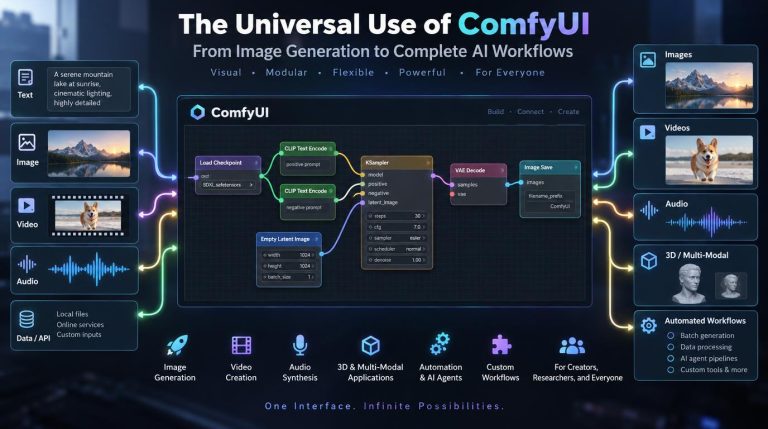
The official repository provides examples using Hugging Face Diffusers and the QwenImage21Pipeline. Qwen also announced Day-0 support from platforms and inference frameworks including ComfyUI, vLLM-Omni, SGLang, and LightX2V.
For developers, this means the model can potentially be integrated into:
- automated image-editing applications,
- e-commerce visualization platforms,
- creative design tools,
- marketing-content generators,
- virtual try-on systems,
- AI photo editors,
- advertising pipelines,
- and custom multimodal applications.
The model’s relatively compact 7B visual-generation component may also make deployment more practical than significantly larger image architectures, depending on hardware, quantization, resolution, inference settings, and workload.
Why Qwen-Image-2.1 Matters
The most interesting aspect of Qwen-Image-2.1 may not be any single feature.
Instead, it is the combination of capabilities within one model.
Historically, an advanced image workflow might require one model for generation, another for inpainting, another for background removal, another for subject preservation, and conventional graphics software for transparent layers and compositing.
Qwen-Image-2.1 moves toward a more unified workflow.
A user can supply images, identify areas to change, describe edits in natural language, combine multiple references, preserve important subjects, manipulate transparent assets, and generate new visual content using one underlying model.
That direction reflects a broader shift in generative AI: image models are evolving from simple generators into general-purpose visual manipulation systems.
Potential Use Cases
Qwen-Image-2.1 could be valuable across a wide range of industries.
E-commerce businesses could place products into new scenes or create virtual outfit combinations. Designers could generate transparent visual assets without manually removing backgrounds. Marketing teams could rapidly produce campaign variants while preserving a brand’s products or characters.
Photographers and creators could experiment with backgrounds, clothing, objects, and compositions using natural-language instructions.
Game studios and creative teams could generate reusable transparent assets, while developers could integrate advanced image manipulation into consumer applications without building a separate model pipeline for every editing task.
Final Thoughts
Qwen-Image-2.1 represents an important step toward more capable and practical open-source image editing.
Its 7B visual-generation component, support for as many as 10 reference images, localized editing controls, native RGBA transparency, improved subject fidelity, and stronger typography make it substantially more than a traditional text-to-image generator.
More importantly, it demonstrates where generative image technology is heading.
The next generation of image models will not simply create pictures from prompts. They will increasingly behave like intelligent visual editors—understanding existing assets, preserving important details, combining references, manipulating specific regions, and producing reusable design elements on command.
Qwen-Image-2.1 is a strong example of that transition.